The Law, Israel, and Politics: Coming to Grips with a Reformed Error
[Note: This article originally appeared on this blog on May 1, 2012.]
In a recent post on his excellent blog, Walter Russel Mead compares the political right in Israel with the political right in America:
Like social conservatives and libertarians in the US, only in a much more polarized way, the right wing of the Israeli electorate includes very religious and very secular voters. The Christian right in the US is mostly focused on a small number of high profile issues like abortion. In Israel, the religious right has a much fuller and more encompassing view on how religion should shape the political agenda. Jewish law in all its complexity, many feel, should be the guiding principle in a Jewish state. The resulting issues go from how strictly should state entities observe the Sabbath to whether ultra-Orthodox students should be able to defer their military service indefinitely.
In part due to its high birth rate, the ultra-orthodox movement is increasingly asserting itself in Israeli politics. And consistent with their allegiance to the old Mosaic Covenant, they want Israel to be run according to the Torah, the Mosaic Law. As the International Crisis Group quotes one ultra-orthodox student:
There’s a new ultra-orthodox generation that wasn’t born in the diaspora but in the land of Israel. It’s the world of those whose roots belong here and who don’t want to abandon the land. They see the crisis afflicting Israel and want to get involved in mainstream politics for the good of the whole society, not just their interest group. They want to see judges wear skullcaps and act according to Torah law.
Classically, of course, Christians rejected the use of the Torah as a definitive authority for the government of Christian lands. Thomas Aquinas went so far as to claim in his Summa Theologiae that if someone follows the Torah’s political and judicial laws simply because those laws are found in the Torah, that person commits a mortal sin (I-II, Q. 104, Art. 3). Christians were to obey the Torah only insofar as it reflected natural law.

Martin Luther, likewise, argued that Christians are not under the Mosaic Law, and that they should follow its political laws only where those laws can be demonstrated to be expressions of natural law. On this basis he initially opposed the use of the sword for the coercion of false teachers or blasphemers. Unfortunately, he later changed his position.
Even John Calvin took a similar position. As he wrote in his first edition of the Institutes, against those who “deny that a commonwealth is duly framed which neglects the political system of Moses, and [which] is ruled by the common laws of nations,” the judicial laws of the Torah are only binding insofar as they are expressions of the timeless demands of natural law, love, and equity:
For the statement of some, that the law of God given through Moses is dishonored when it is abrogated and new laws preferred to it, is utterly vain… For the Lord through the hand of Moses did not give that law to be proclaimed among all nations and to be in force everywhere (4.20.14-16).
In fact, it is little known that in the first edition of theInstitutesCalvin criticized the use of the sword for religious persecution. Speaking of the love with which Christians should seek to reconcile those who are excommunicated, as well as “Turks and Saracens, and other enemies of religion,” he wrote:
Far be it from us to approve those methods by which many until now have tried to force them to our faith, when they forbid them the use of fire and water and the common elements, when they deny them all offices of humanity, when they pursue them with sword and arms (1536 Institutes, 2.28).
This is promising stuff. Unfortunately, Calvin dropped that quote from subsequent editions of the Institutes (except, fascinatingly, the final French edition). In practice, he defended government’s use of the sword to punish violators of all of the Ten Commandments, especially in his commentaries and sermons on the Torah. Both Lutheranism and Calvinism became known for their turning to the example of Old Testament Israel as a model for Christian commonwealths. Like the Israelite kings, godly magistrates were to enforce all of God’s laws, including those laws regulating preaching and worship.
It’s not that they didn’t know opposing arguments. In addition to their early positions, as described above, Luther, Calvin, and the other reformers were consistently confronted with arguments from Anabaptists, Evangelical pastors, prominent civil officials, and various intellectuals, to the effect that Christians are not under Israel’s Torah, and that therefore the example of Old Testament Israel did not justify the use of the sword for religious persecution. As one civil official in the city of Nurnberg put it:
Now it is certainly true that the Old Testament no longer binds any man, and if we are bound in one matter on the ground that it is commanded in the Old Testament, how shall we avoid being bound in other such matters? If one thing were necessary, they would all be necessary, as Paul clearly concludes in Gal. 5[:3] and says against those who wanted to make circumcision obligatory: Whoever has himself circumcised is obliged to fulfill the whole law. Therefore we must not be bound by anything in the Old Testament but rather give heed to the New Testament.
Our views of the Mosaic Covenant, of the Torah, and of their relation to politics in the present age are tremendously important. Christians still debate this stuff vigorously today, although the “dominionists” and “theonomists” make up only a small minority within Evangelicalism. Is God’s purpose for modern day America (or for modern day Israel, for that matter), for us to be an imitation of Old Testament Israel, under that Law that Christians – according to Aquinas, Luther, and Calvin in their better moments – have been freed from?
Thankfully in time the Reformed tradition came to see the mistake in insisting that civil magistrates are to enforce the true religion, and both the Westminster Confession of Faith (the Presbyterian confession) and the Belgic Confession of Faith (the Dutch Reformed confession) were modified to eliminate that requirement. Nevertheless, I can’t help but think that in part this was simply a shift of convenience. When separation of church and state and religious liberty is so popular all around us, it is hard to keep such an intolerant confession. Have we ever really come to grips with the crucial theological and covenantal issues that led our tradition down the wrong path in the past? Do we still think that in some ideal sense we are “under the Torah”? There still needs to be so much discussion on this topic.
Natural Law in the UN’s Universal Declaration of Human Rights
[Note, this post originally appeared on this blog on April 26, 2013.]
One of the common truisms I regularly come across in banter emanating from across the political and religious spectrum is that natural law is a theoretical concept devoid of any practical substance or significance. Natural law, its critics claim, produces no certain knowledge. It is more often merely the rhetorical projection of whatever a person firmly believes but finds herself unable to prove. Appeals to natural law never solve moral conflict. On the basis of natural law people on the right and the left come to radically contradictory conclusions about matters as fundamental as marriage, human life, and property. Better to find a clearer, more widely accepted basis for morality.
What is that alternative basis? Ask many conservative Christians and they will tell you it is the Bible. To be sure, the authority of the Bible is not as widely accepted as it once was, but it is still more widely accepted than any other “objective” standard. What’s more, these conservative Christians will tell you, it has the advantage of clarity. It may not answer every moral question that we have but it certainly settles the most important ones.

Really? Dig a little deeper into the blogosphere or media of any particular religious tradition and you will find that even among those who embrace the authority of Scripture there is a lot less agreement about the practical implications of what Scripture teaches than these broad appeals to the Bible would suggest. Look back into the history of Christianity and you will find even more disagreement. There is no uncontested conservative Christian consensus on moral issues as basic as slavery, war, women’s rights, poverty, or freedom of religion.
What’s more, when one takes into account different assumptions about the political implications of Scripture’s clear moral teaching the field gets even more complicated. Libertarians and theonomists, liberals and conservatives, democrats and authoritarians, nationalists and universalists all find a place under the broad Christian tent. Among these there is no consensus about the political implications of a myriad of moral subjects addressed with more or less clarity in Scripture.
And to remind you, this is just to highlight disagreements among theologically conservative Christians. The political usefulness of the Bible as a public authority is seriously limited even before we take into account the fact that most members of our society do not accept it as a decisive authority in their lives at all.
But does that leave us without any basis for a shared public morality? No it does not, despite the apparent widespread cynicism about natural law. Step back from the more controversial political disputes of our time and you will discover much more of a public moral consensus than you might at first expect. Read the writings of almost any prominent ethicist or political theorists and you will discover appeals to broadly shared principles such as the golden rule, basic human rights, or principles of reciprocity and fairness. They might not like the term natural law and they might adamantly reject particular versions of natural law theory, but they still find themselves assuming its reality and even its concrete principles. Even the pagans know, as Calvin often said, that there are basic human values to be protected with laws backed up by coercive institutions.
In fact, in our own time there is even greater basis for confidence in the value of natural law than there was in the time of Thomas Aquinas, John Calvin, or John Locke. We actually have a developing system of international law recognized throughout the world. We have the United Nations, which, problematic as it is, is still a political body in which all nations are represented. Perhaps most obviously, we have the United Nations Universal Declaration of Human Rights, a document that comes as close to being a statement of shared universal morality as the world has ever known. Natural Law is at work. Consider these articles:
- Article 1: All human beings are born free and equal in dignity and rights.They are endowed with reason and conscience and should act towards one another in a spirit of brotherhood.
- Article 3: Everyone has the right to life, liberty and security of person.
- Article 6: Everyone has the right to recognition everywhere as a person before the law.
- Article 12: No one shall be subjected to arbitrary interference with his privacy, family, home or correspondence, nor to attacks upon his honour and reputation. Everyone has the right to the protection of the law against such interference or attacks.
- Article 16:
- (1) Men and women of full age, without any limitation due to race, nationality or religion, have the right to marry and to found a family. They are entitled to equal rights as to marriage, during marriage and at its dissolution.
- (2) Marriage shall be entered into only with the free and full consent of the intending spouses.
- (3) The family is the natural and fundamental group unit of society and is entitled to protection by society and the State.
- Article 18: Everyone has the right to freedom of thought, conscience and religion; this right includes freedom to change his religion or belief, and freedom, either alone or in community with others and in public or private, to manifest his religion or belief in teaching, practice, worship and observance.
- Article 25
- (1) Everyone has the right to a standard of living adequate for the health and well-being of himself and of his family, including food, clothing, housing and medical care and necessary social services, and the right to security in the event of unemployment, sickness, disability, widowhood, old age or other lack of livelihood in circumstances beyond his control.
- (2) Motherhood and childhood are entitled to special care and assistance. All children, whether born in or out of wedlock, shall enjoy the same social protection.
- Article 26
- Everyone has the right to education …
- (3) Parents have a prior right to choose the kind of education that shall be given to their children.
Of course there are still major disagreements. Many people despise the UN Declaration of Human Rights, while even those who embrace it disagree with it at various points. Others reject common assumptions about what enforcing the rights enumerated in the Declaration requires on a political level. Just as importantly, the Declaration sets out only the broadest of frameworks for justice. It is tragically short on duties. It leaves tremendous room for conflict, abuse, or rationalized injustice. In so many ways, like any morality, it is more a statement of unrealized ideals than of practical political reality.
Still, it remains a widely shared statement of universal morality, embraced by people of all sorts of religions and creeds. It remains precisely the sort of evidence for natural law to which theologians like Aquinas and Calvin pointed in their own times. I would argue that conservative Christians have avoided formulating their political convictions about abortion, marriage, child-rearing, education, and sexuality in terms consistent with the Declaration at their own peril.
There is a much stronger foundation for a public morality shared between Christians and nonbelievers, liberals and conservatives, than we are often willing to admit. Truth, thanks to common grace, still has tremendous power. If you are in doubt about what our society would really look like were this shared morality to evaporate you don’t know history very well. What we have is far from perfect, but it’s far from useless as well. Natural law is at work.
Is Women’s Modesty the New Legalism Among Christians?
[Note: This article originally appeared on this blog on July 26, 2012. When I originally published it there was some controversy, as a number of people feared that I was in some way promoting antinomianism. Such is not the case, at all. Here is a sermon I preached on Jesus' warning against lust in Matthew 5:27-30.]
Contemporary America is one of the most sexualized cultures in the history of the world. Sex is everywhere, no matter how hard you try to avoid it, and the objectification of women in virtually every form of media is a commonplace. In this context, it is easy to see why many Christians react by placing tremendous stress on women’s modesty, not only in principle, but in terms of a system of rules and practices designed to cover and obscure the skin and curves of a woman’s body. In certain conservative circles the rhetorical and moral condemnation of those women who do not conform to the strict (and sometimes arbitrary) standards of others is quite intense. In many ways it is analogous to the fundamentalist approach that Christians took toward alcohol in the early twentieth century. The cultural problems caused by drunkenness and strong liquor were tragic and required a response, but the response of many Christians was more legalistic than realistic, more about control than about the gospel.
Of course, the problem with an issue like modesty is that one can always take a stricter, more modest position than the next person. Person A says women should always wear skirts, never pants. Person B says women’s skirts should always extend below the knees. Person C says women should never show their ankles or hair. Person D says why not just put on a burqa? Men don’t lust after women in burqas (or do they?). On the other hand, once one opens the door to Christian wisdom and liberty, where do you stop? In some cultures women freely show their breasts, even in church. Even in Victorian England it was suitable to show significant cleavage but not your ankles.

In his classic Mere Christianity C.S. Lewis writes,
The Christian rule of chastity must not be confused with the social rule of ‘modesty’ (in one sense of that word); i.e., propriety, or decency. The social rule of propriety lays down how much of the human body should be displayed and what subjects can be referred to, and in what words, according to the customs of a given social circle. Thus, while the rule of chastity is the same for all Christians at all times, the rule of propriety changes. A girl in the Pacific islands wearing hardly any clothes and a Victorian lady completely covered in clothes might both be equally ‘modest,’ proper, or decent, according to the standards of their own societies: and both, for all we could tell by their dress, might be equally chaste (or unchaste)…. When people break the rule of propriety current in their own time and place, if they do so in order to excite lust in themselves or others, then they are offending against chastity. But if they break it through ignorance or carelessness they are guilty only of bad manners. When, as so often happens, they break it defiantly in order to shock or embarrass others, they are not necessarily being unchaste, but they are being uncharitable. (83-84)
Often lost in all of this is that when the New Testament talks about modesty it is always concerned about women who put too much emphasis on their clothing, jewelry, and hair, forgetting that what it means to be a Christian woman is about godly actions that stem from the heart, not about what one wears. If anything, Paul’s writings show that he was concerned about wealthy women drawing too much attention to themselves through their physical adornment. Throughout much of human history, and one sees this in the descriptions of the adulterous woman in Proverbs as well, sexual immodesty had to do with the kind of clothing and makeup a person put on to draw attention to herself, not with the showing of skin. And Jesus puts the burden of preventing lustful thoughts on Christian men, not on Christian women.
I am not saying women should dress provocatively, or that it is acceptable for them to show as much skin as possible. I am suggesting that there is nothing inherently immodest about showing the skin on most parts of the human body or about wearing clothing that accentuates certain curves. As Christians we should be careful not to commit the Muslim mistake of thinking that we need to hide a woman’s body in order to make life easier for men, or that feminine beauty is something that we should flee from and avoid rather than celebrate and enjoy. The problem is with the human heart (lust) and the actions that spring from it (sexual immorality and adultery), as Jesus made quite clear to the Pharisees who were prone to their own forms of legalism. It is not with women, or with the bodies that God has given to them.
One of the most helpful set of posts I have seen on this is by Rachel Miller at her blog, A Daughter of the Reformation. As Miller writes, responding to a post on another blog praising the merits of women wearing skirts,
Skirts are not inherently more modest than pants. Modesty is much more an issue of the heart than simply what a woman wears. A skirt can easily be provocative, and it’s not hard to be modest in pants, or shorts, or even a swimsuit. And, there is a real danger for many women to become self-righteous over their choice of clothing.
Miller illustrates her point with a clever set of pictures. The link in the quote leads to a more substantive post she wrote on the issue. There she writes,
In reading the Scripture verses that deal with modesty and clothing, I noticed something. First, I noticed that Scripture gives very little by way of specifics as to what modest clothing looks like. Second, I noticed that Scripture speaks more about what might be termed “inner beauty.” (Again, I want to be clear that I am not disagreeing with those who see the need to address the practical issues related to dressing with modesty.)

Noting the relevant biblical passages, she goes on with reference to 1 Timothy 2:8-10,
While we could certainly get into a debate about whether women should braid their hair or wear jewelry, I think the point Paul is making here is that godly women should not worry so much about their outward appearance, but they should concern themselves with living godly lives. Our love for God and His love for us should make us care more about what He thinks of us and less about what the world around us thinks.
This is a very freeing concept. Women and girls who know that they are loved by God, not for anything they’ve done or anything they are, but solely because He has chosen to love them, are freed from the constant struggle for acceptance by the world.
One might add that it frees Christian women from the constant scrutiny of those to the right of them on the modesty spectrum.
Here again the comments of C.S. Lewis are helpful:
I do not think that a very strict or fussy standard of propriety [i.e., modesty] is any proof of chastity or any help to it, and I therefore regard the great relaxation and simplifying of the rule which has taken place in my own lifetime as a good thing. At its present stage, however, it has this inconvenience, that people of different ages and different types do not all acknowledge the same standard, and we hardly know where we are. While this confusion lasts I think that old, or old-fashioned, people should be very careful not to assume that young or ‘emancipated’ people are corrupt whenever they are (by the old standard) improper; and, in return, that young people should not call their elders prudes or puritans because they do not easily adopt the new standard. A real desire to believe all the good you can of others and to make others as comfortable as you can will solve most of the problems. (84)
Again, the point is not that women should wear whatever they want without thought to modesty, or that they should dress provocatively. The point is that we should be very careful not to make arbitrary external rules our obsession, rather than the heart and the actions that stem from it, and that we should be careful not to fall into the trap of implicitly viewing women and their bodies as evils that are to be avoided or hidden. As a virtue of the gospel, modesty calls us to sanctify our hearts even as we celebrate that what God has made, including women created in his image, is very good.
[Note: the C.S. Lewis quotes have been added to the original version of this post]
Thank You Readers: “Christian in America”‘s First Anniversary
Blogging will be light while I’m traveling during the next couple weeks. Later this week I’ll be giving a paper on “John Calvin as a Two Kingdoms Theologian” at a Reformation anthropology conference in Berlin. The following week I’ll be visiting with my wife’s family in Poland. I may or may not put up a few posts; we’ll see how things go. At the very least I’ll re-post a few classics, posts many of my more recent readers haven’t yet had a chance to see.

Last month Christian in America reached its one year anniversary. It passed with little fanfare. Although maintaining this site for a year has at times been a greater commitment than I would have liked, I am tremendously grateful for how things have worked out. Posts routinely get 300-400 hits, and the most popular ones get well over 1,000. Although I started out posting six days a week, I’ve been able to reduce my writing commitment to a more sustainable two or three times per week while gradually increasing blog traffic in absolute terms.
Far more important than the stats, of course, are you, my loyal readers. None of this would be worth it if you did not faithfully keep coming back, ignoring the weak posts where it’s clear I’m not thinking entirely straight, offering helpful criticism, or giving your encouragement and support when you’ve found my writing helpful. I’ve received generous messages from professors, students, elementary school teachers, state representatives, pastors, reporters, lawyers, dads, moms and Christians serving in all sorts of other vocations and circumstances of life. They tell me that what you read here has in some way or another helped you to think through what it means to be a faithful Christian in America (or some other country). I’m very grateful for this encouragement, and even more so for the fact that my work has occasionally attained some practical value for you.
Because that has always been the main motivation here. This blog is not designed to be a focal point for controversy, nor is it designed merely to stimulate a particular professional or theological audience. I write for ordinary Christians, seeking to help you think through some of the controversies, problems, and opportunities of our time, with a special eye toward politics. I try not to react to events or arguments with talking points or cliches, the sorts of things people have come to expect from many Christians. But I do try to challenge common assumptions about theology or politics, rethinking the implications of the Christian faith for public life from the perspective of Scripture and the gospel of Jesus Christ.
I write from a Reformed perspective, but I also wrestle with the Reformed political theological tradition. Every healthy tradition or community, I believe, must challenge and reinvigorate itself through reflection, conversation, and self-criticism, bringing the wisdom of both past and present into conversation with reference to the practical issues of our life together. It’s our duty as Reformed Christians to wrestle with what we have done well and what we have done poorly, with what we bring that is helpful to Christians of other traditions and what we need to learn from them. I seek to do this with humility and in a spirit of Christian unity. I also do so out of a sense of love and obligation to our neighbors in this country who do not share our faith. The ultimate goal is to remain faithful to our calling to reflect the image of Christ by serving one another in love.
So I want to take this opportunity to say thank you to all of you, and to ask for your continued support and constructive criticism. I hope and pray that my work will be helpful to you during year 2.
Do Christians Think Congress Should Be Opened With Prayer to Allah? Thoughts from Brian Lee
In the Daily Caller on Wednesday Brian Lee wrestles with the question of whether he should have opened the House of Representatives with prayer last week. This is not a case of it being easier to ask for forgiveness than for permission. Lee admits that he was always a bit torn, and that there are arguments both for and against what he did. Generic civil religion, he points out, is worse than problematic for Christians.
Lee, however, did not offer a generic prayer of civil religion last week. He helpfully explains the way he understands what he did as follows:
A church is a particular worshiping community, a creedal body, because it prays to a particular God. When I pray publicly in church, I therefore pray in the first person plural. That is, I pray in common and on behalf of every member of that community…
To whatever degree “Christian” may describe America, we are quite obviously not a creedal nation. Membership in Congress is explicitly not subject to a religious test; it is in this sense an anti-creedal body. It is therefore impossible for me to pray before Congress as I pray in church, on behalf of the assembled body, for Congress does not have an agreed-upon God. However, while I may not be able to pray on behalf of people who don’t share my faith, I can certainly pray for them. In this way, I occasionally pray for sick unbelievers when I’m invited to visit them in the hospital.
Christians must not presume false unity within a pluralistic group by praying in the first person plural on their behalf. If we do pray in such settings, we must pray as individuals, to a particular God, for the group. And indeed, this seems to me most consistent with the pluralistic character of our polity, that we retain our religious distinctiveness even as we enter the public square, instead of pretending as though there is none.
I think Lee gets this just right. But he goes on to note that this perspective gives rise to a poignant problem.
Should the House tolerate prayers like mine, offered in the name of Christ? Only, it seems to me, if it is also willing to accept prayers written in the name of Allah, Buddha, Gaia, or Zeus. My guess is this pluralistic version of Pascal’s wager would enjoy a lot less popular support than generic prayers to a nameless God, and the practice would soon pass away entirely.

Are most Christians OK with the U.S. House of Representatives asking practitioners of other religions to open House functions with prayer? In a sense this was not Lee’s problem when he was asked to lead the House in prayer. That’s why he stands by what he did. As he puts it,
Why then did I accept? God is near to those who call on him in faith. If someone asks a Christian to pray for them — especially a Christian minister — and you can do so in truth, with the love of Christ, and without violating your conscience, you accept.
As my father always said, if he was asked to preach in a mosque he would do it, as long as he was free to preach the gospel. But that doesn’t answer the question of whether a democratic nation, our nation, should request prayers not only from Christians, but from Muslims, Buddhists, or others. If we are OK with this, as Lee seems perhaps to be, how do we justify allowing a political body that represents us to promote what we regard as idolatry? If we are not OK with this, it seems that we should either be consistent and call for the establishment of the Christian religion, or we should oppose such prayers entirely.
What do you think?
Why Calvin Rejected Religious Liberty: Scott Clark on the Servetus Case
At the Heidelblog last week, and since republished on the Aquila Report, my friend Scott Clark writes a helpful response to dismissals of Calvin as the “tyrant of Geneva,” dismissals closely related to caricatures of Calvinism as a cold, authoritarian, and fatalist religion. Clark reminds us that it was not Calvin who sentenced the heretic Servetus to death, but the civil government of Geneva. More importantly, he points out that this took place during an age in which civil authorities throughout Europe, aligned with Rome, were killing thousands upon thousands of Protestants. Clark’s post is well worth reading in its entirety.
All of the leading magisterial reformers defended putting heretics, including Anabaptists, to death. Indeed, as Clark points out, Zwingli, Luther, Melanchthon, and Bullinger and other leading reformers were just as vocal in their defense of such policies as was Calvin. The reformer gets the extra press today because he is associated with a social movement that has had an impact far beyond its numbers. Luther, of course, gets bad press for his own blemishes and their supposed legacy in history.

Clark has no interest in defending the reformers’ complicity in the suppression of religious liberty. A strong two kingdoms advocate, he writes,
Was it a confusion of the civil and ecclesiastical spheres for Calvin to demand civil penalties [against one of his severe public critics] for being identified with the sufferings of Christ? Absolutely. From the perspective of a distinction between the ecclesiastical and common spheres, Calvin might have had a case before the Consistory but not before the Civil Authorities.
The true moral of this story, however, is of the danger of the Constantinian church-state alliance wherein civil authorities have the power to punish heresy. Nowhere in the New Testament or in the moral law is theological heresy a ground for civil punishment. The only sphere authorized by God to correct theological error is the visible church (see Matthew 18) and their means are purely spiritual: Word, sacrament, and discipline (e.g., rebuke, censure, excommunication).
With all of this I agree, and I appreciate Clark’s putting Calvin’s actions in historical context. That said, I do think more needs to be said than simply that Calvin was a product of his time, that nearly everyone in Europe agreed Servetus should be put to death for denying the fundamentals of Christianity (not simply of the Reformation), and that in any case, it was not Calvin who technically condemned and burned Servetus, but the government of Geneva.
The fact is, Calvin was a vocal and dogmatic apologist for the suppression of religious heresy. He was severely criticized for his complicity in the execution of Servetus, and the theological fighter that he was, he wrote repeatedly in defense of his actions and those of his government. He considered the arguments that Clark raises above and rejected them on theological grounds. Had Clark made these arguments in Calvin’s Geneva, Calvin would have said that he simply “desire[s] to be at liberty to make disturbances with impunity.” There is no need for me to recap all of that here, as I’ve written on it before. But here is a brief sampling of Calvin’s arguments, drawn from his commentary on the Law.
But it is questioned whether the law pertains to the kingdom of Christ, which is spiritual and distinct from all earthly dominion; and there are some men, not otherwise ill-disposed, to whom it appears that our condition under the gospel is different from that of the ancient people under the law, not only because the kingdom of Christ is not of this world, but because Christ was unwilling that the beginnings of his kingdom should be aided by the sword.
Calvin is aware of these arguments, and he agrees both that the use of the sword is alien to the spiritual kingdom of Christ and that Christ does not need it for his kingdom’s success. However, he insists that God can nevertheless require that magistrates promote and defend the true religion merely because it is his will that such be part of their earthly vocation. In essence, he simply denies that capital punishment for false doctrine is a confusing of the kingdoms.
But when human judges consecrate their work to the promotion of Christ’s kingdom, I deny that on that account its nature is changed… He did not impose on himself an eternal law that he should never bring kings under his subjection, nor tame their violence, nor change them from being cruel persecutors into the patrons and guardians of his church.
He then denies that any contrary conclusions should be drawn from Jesus’ silence (and in general, that of the New Testament) on this magisterial responsibility. This is the weakest part of Calvin’s argument, it seems to me – his lack of any clear New Testament support for his position. He attempts to make up for it by appealing to three passages – the same three passages he invokes in at least half a dozen places in his writings where he discusses the issue – that he thinks prove that even in the Christian era magistrates are to enforce the true religion: Psalm 2, Isaiah 49;23; 1 Timothy 2:2. Again, I’ve addressed his appeal to such texts here.
Why does it matter? I’m sure some Reformed people will read this blog post and complain once again that we shouldn’t be criticizing our forebears on matters that aren’t even controversial anymore. Why beat a dead horse? It simply threatens the credibility of our theological tradition, doesn’t it?
I disagree. I care more about the Reformed tradition than about Calvin’s particular political opinions, and the credibility of the Reformed tradition depends far more on whether or not we take seriously the legacy and theology of the past than on whether we can manage to whitewash our history with hagiography. In this case, I firmly believe, many in the Reformed tradition, along with many Evangelicals in general, have not come to grips with why we disagree (or should disagree) with our forebears who opposed religious liberty.
We think they were simply products of their time. As if, were Calvin to appear in the 21st Century, he would suddenly agree with us. As if we were not products of our time as well. And as a result, we never come to grips with the theological mistakes the reformers made that led them to the positions we now oppose. Calvin supported the suppression of religious liberty in part because, influenced by Plato, Cicero and others, he held certain assumptions about the nature of the Mosaic Law and of Israel, and about their normativity for Christians. He believed that magistrates were called to enforce the law of God as revealed in Scripture, unto the glory of God. He failed to see why the first table of the law (i.e., worship and piety) should be excluded from that principle.
Read a smattering of Evangelical political arguments on a host of issues today – abortion, homosexuality, economics, health care, etc. – and you will find that many Evangelicals hold the same assumptions about the simple correlation between Scripture (and the example of Israel) and politics. The only difference was that Calvin was much more consistent than they are. He didn’t exclude idolatry, blasphemy, sabbath-breaking, or adultery from the political realm. That modern Evangelicals do so is usually not so much because they understand the theological problems with Calvin’s (and the other reformers’) views, but because they, even more than Calvin, are products of their time.
But is there a biblical theological foundation for a democratic society that values religious liberty? That, for me, is what is at stake here. That’s why we need to keep hashing through the counter-arguments of our theological forebears, arguments that were better and more theologically rigorous than we are usually willing to admit. We need biblical theological arguments for democratic pluralism and religious liberty that seriously come to grips with the Christian political theological tradition and come out on top. Calvin’s political theology may have been a product of its time. It’s up to us to work as hard as we can to ensure that ours is a product of Scripture.
[Note: All the Calvin quotations are from his Commentary on Deuteronomy 13:5]
Brian Lee’s Prayer for the Government
In the House of Representatives on Monday Brian Lee, pastor of Christ Reformed Church in Washington D.C., prayed the following words:
Creator God, merciful and just.
You dwell above in holiness, a father to the fatherless, protector of widows and orphans. Dear Lord, rescue the weak and needy, deliver them from the hand of the wicked.
Give wisdom to this body. You hold all things in your almighty hand, and you have established this House of Representatives — and every governing authority — as your servants, that they might protect the defenseless, praise those who do good, and punish those who do evil.
Preserve and protect our President.
Humble all these your servants with your holy law, which you shine forth in all our hearts. Help them to seek peace.
You are a God who saves. Convict us of all our sins, that we might know deliverance from these our wicked ways.
Hear this prayer, for the sake of the merits of your only Son, the crucified and risen Lord, Jesus Christ. Amen.
![]()
I’m not in the habit of analyzing or critiquing public prayers on this blog, but I do want to point out a few things that make Lee’s prayer exemplary. Remember, this is not only a prayer for the state (per 1 Timothy 2:1-2), but it is offered in an official, public setting. The temptations here are enormous, but Lee avoids them nicely, while offering intercession of substance:
- Temptation: to pray on behalf of all people, regardless of faith. Lee studiously avoids the first person plural except when describing those for whom he is praying. The “us” here is the object, not the subject.
- Temptation: to pray to a generic civil deity. Lee prays explicitly to the God of, and on the basis of the merits of, the crucified and risen Lord Jesus Christ.
- Temptation: to imply that the United States is somehow God’s chosen or uniquely favored nation. Lee declares that all governing authorities are established by God as his servants.
- Temptation: to pretend that our fundamental need is for God to prosper our national goals. Lee prays for protection, but he also prays for wisdom, humility, the knowledge of God’s law, and the conviction of sins.
- Temptation: to pray for a particular partisan or ideological agenda, thus politicizing the prayer. Lee carefully prays that those in authority would be humbled by God’s holy law and that they would seek peace. He describes government’s task in biblical terms: protect the defenseless, praise those who do good, and punish those who do evil.
What faithful Christian could not pray this prayer? What Christian, of any nation, could wish that this prayer would not be answered?
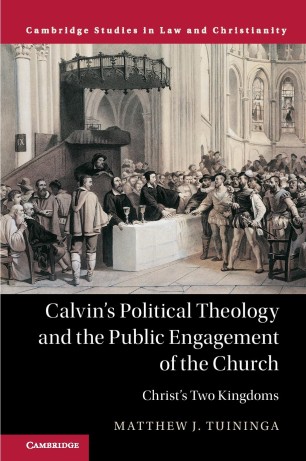
(Note: the painting above does not feature Brian Lee. His wig is much less stylish.)
Brian Lee to Serve as Guest Chaplain in House of Representatives

My friend Dr. Brian Lee, pastor of Christ Reformed Church in Washington D.C., will be serving as a guest chaplain in the House of Representatives today. Lee will be offering the opening prayer for the pro forma session at 2 pm this afternoon. You should be able to watch it live here.
Lee has years of experience working in for the federal government in various capacities. He’s also done some excellent writing on questions of religion and politics, and has been a helpful contributor to discussions about two kingdoms theology.
Congratulations Brian!
The Christian Perspective on the War in Syria
We are living through the second coldest spring in American history but in the Middle East the Arab Spring is only getting hotter. Some 70,000 people have been killed, many of them civilians, in the past two years of fighting in Syria. Bloodshed in Iraq is on the upswing again, and fears are rising that the country is sliding back into war. Iran continues to defy western pressure as it works its way to nuclear capabilities the Obama administration has said will not be tolerated. Iran supplies the Syrian government with much of its weapons and equipment, much of which, it appears, passes through the territory of its ally Iraq, the country for whom so many Americans lost their lives and to which America devoted so many billions of dollars. In addition, consider the festering failure of US and Afghan forces to establish a peaceful stability in Afghanistan, or the fact that the one Muslim country in the region that already possesses nuclear weapons – Pakistan – has terrorists and their prominent sympathizers holding important posts in the government.

The consequences for Christians have been abysmal. Large minority communities with centuries of tradition and history have been tragically shattered amid the chaos and the resulting surge of Islamist forces across the region. For these Christians times were certainly better under Saddam Hussein, Hosni Mubarak, and Bashar al-Assad than they are under the forces and regimes supported by the United States.
The Bush administration is to blame for much of this mess, of course, including the chaos ricocheting out of Iraq. But one virtue of the Bush administration was that it sought to explain to the American people what is at stake in various conflicts to which American troops are committed. Under President Bush, Americans could be confident that their government was not afraid to make the hard decisions necessary to secure our national security interests in the region.
Under President Obama, on the other hand, there hasn’t been much of a message to Americans at all. When has the president addressed the war in Afghanistan, or the now “ended” war in Iraq, in terms that would prepare the American public for the sacrifices expected of them? Even worse, the signals radiating from the White House in the Middle East since Bush left office have amounted to a lot of hard talk backed by little of substance.
The obvious example, of course, is Iran. President Obama has made it clear that the United States will not tolerate Iran’s development of a nuclear weapon. Military force would be used if necessary. But there is no evidence that Iran has slowed its progress, or changed its intentions at all. The president has been right to put off war up to this point. Even if it would be just to go to war against Iran over its nuclear program, such would obviously only be the case as a last resort. In the meantime, however, it is imperative that the United States communicate strength in the region, a willingness to back up its talk with power, lest Iran doubt that President Obama means what he says. One way to do that is to make sure that when the United States draws a red line and threatens consequences once that line has been crossed, it is not an empty bluff.
For months now the President has been saying that if Assad used chemical weapons it would be a “game-changer,” there would be clear consequences. Now Israel, Britain, France, and the United States (the latter with less official “certainty”) have concluded that Assad has used such weapons, probably in just the degree that suggests he is testing the president’s mettle. Yet the United States has dithered. The White House claims that certainty needs to be established, especially given what happened in Iraq last decade. Fair enough. But the stakes are high. If the United States, whether intentionally or unintentionally, somehow communicates to Iran that it does not mean what it says when it talks about red lines, war in the region will be far more likely, not less likely.
Most Americans, of course, understandably want nothing to do with another war in the Middle East. Neither Iraq nor Afghanistan have ended well. Even Libya seems to have had consequences more negative than positive. Will intervention in Syria really achieve anything more than taking a big problem and making it a big American problem? On the other hand, interventionists like Senator John McCain argue that all the terrible things non-interventionists said would happen if we went into Syria have happened anyway. The conflict is spilling over into Turkey, Lebanon, and Iraq. Chemical weapons have been used. The radical contingent of the rebel forces is growing in strength, and Syria increasingly looks like yet another excellent training ground for Islamist terrorism. Isolationists might imagine that the United States could just walk away from all of this, but such optimism is based more on dreams than on a careful analysis of the situation in view. If the last four years are any indication, a weakening U.S. presence in the region is likely to make matters worse rather than better.
What is the Christian perspective on all of this? Approximately ten percent of the population of Syria is Christian, a total of some 2.3 million persons. As in Iraq and Egypt, the Christian population in Syria has often been identified with the old tyrannical regime, a regime that was politically repressive but that permitted meaningful religious liberty. Today Christians in Syria certainly worry that the fall of Assad would lead to tragic consequences for their own communities. Many (probably some 300,000) have already fled the country.
Christians occupy prominent political and military posts within the Assad regime. According to the British newspaper The Guardian, “Bishop Khouri, who is known as an ultra-loyalist, accused western countries of betraying their own religious heritage by backing the rebels.” There is also something to be said for the Christian aversion to insurrection and rebellion, in line with both the spirit and the letter of New Testament teaching.
Other Christians in Syria, however, rightly point out that the Assad regime has lost all credibility or ability to govern. They claim that the government has intentionally characterized the rebel opposition as radical Islamist in order to prevent U.S. intervention. As The Guardian reports, “The Syrian National Coalition, the main western-backed anti-Assad grouping, has tried to avoid any whiff of sectarianism … Its current leader, the respected George Sabra, is a Christian.”
Although it increasingly looks like the battle lines in the Middle East are being drawn between Shiites (Iran, Iraq, the Assad regime) and Sunnis, Christians are caught in the middle. Perhaps the view of most Syrian Christians is best represented by the Syrian taxi driver Abu Jean.
Christians should be neutral. But this is not our business. I will not let my son join the [government] popular committees or the national defence army – or the armed opposition either.”
But it’s not easy to remain uninvolved. These people are Syrians, as well as Christians. Syria is their country. It’s government clearly has to go. Yet while many reject the heavy-handedness of a regime that is now using chemical weapons against its own people, they are also wary of the consequences of a more democratic Syria, given what has taken place in Egypt and Iraq.
What a mess.